
A broker can look cheap at first glance and still cost more over time than a competitor with a higher advertised rate. That is usually because when traders ask what fees do brokers charge, they focus on one number, often the spread or a headline commission, and miss how the full cost structure works in real trading conditions.
For forex and multi-asset trading, broker fees usually fall into two categories: trading fees and account-related fees. Trading fees affect every position you open and close. Account-related fees depend on how you fund, hold, or leave your account inactive. The right comparison is not just which broker has the lowest published fee. It is which broker has the lowest realistic total cost for your trading style, instrument mix, and account size.
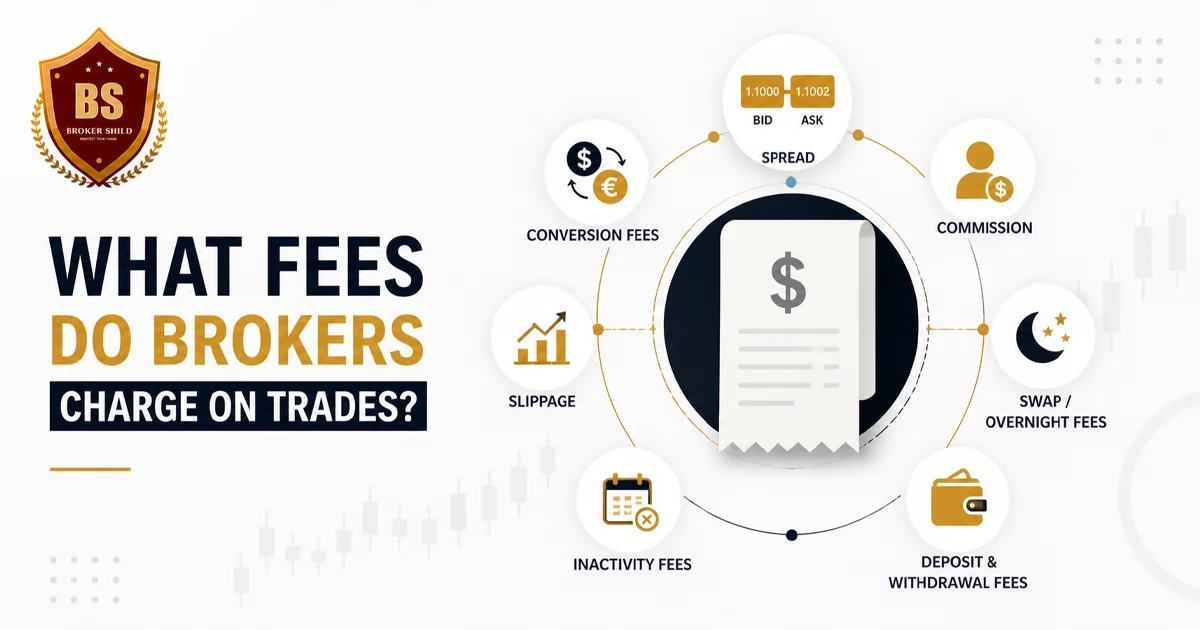
The core cost of trading usually comes from spreads, commissions, or a combination of both. The spread is the difference between the buy price and the sell price. If EUR/USD is quoted at 1.1000 and 1.1001, the spread is 1 pip. That spread is a direct cost because you begin the trade slightly negative.
Some brokers build their fee entirely into the spread. These are often called spread-only accounts. They can look simple and are easier for beginners to understand because there is no separate commission line. But simplicity does not always mean lower cost. A broker with a 1.2 pip spread and no commission may be more expensive than a broker with a 0.2 pip spread plus a fixed commission per lot.
Commission-based accounts separate the spread from the broker’s service charge. In many cases, the raw spread is tighter, sometimes close to zero in liquid market hours, and the broker charges a set amount per side or per round turn. This structure is common among active traders because it makes pricing more transparent. It also makes broker comparisons easier if the commission is clearly stated.
Then there is slippage, which is not always listed as a fee but still affects cost. If your order is filled at a worse price than expected, your effective trading expense rises. This matters most in fast markets, around major news releases, or with thinly traded instruments. A broker with low published spreads but poor execution can end up costing more than a broker with slightly wider spreads and more consistent fills.
Neither model is automatically better. It depends on how you trade. If you place small, infrequent trades, the convenience of a spread-only account may be acceptable. If you scalp, day trade, or use larger position sizes, even a small difference in spread can materially change your monthly cost.
For example, a trader opening multiple EUR/USD trades per day will usually care more about all-in cost per round trip than about whether the charge appears as spread or commission. A swing trader holding positions for days may care less about a fraction of a pip and more about overnight financing.
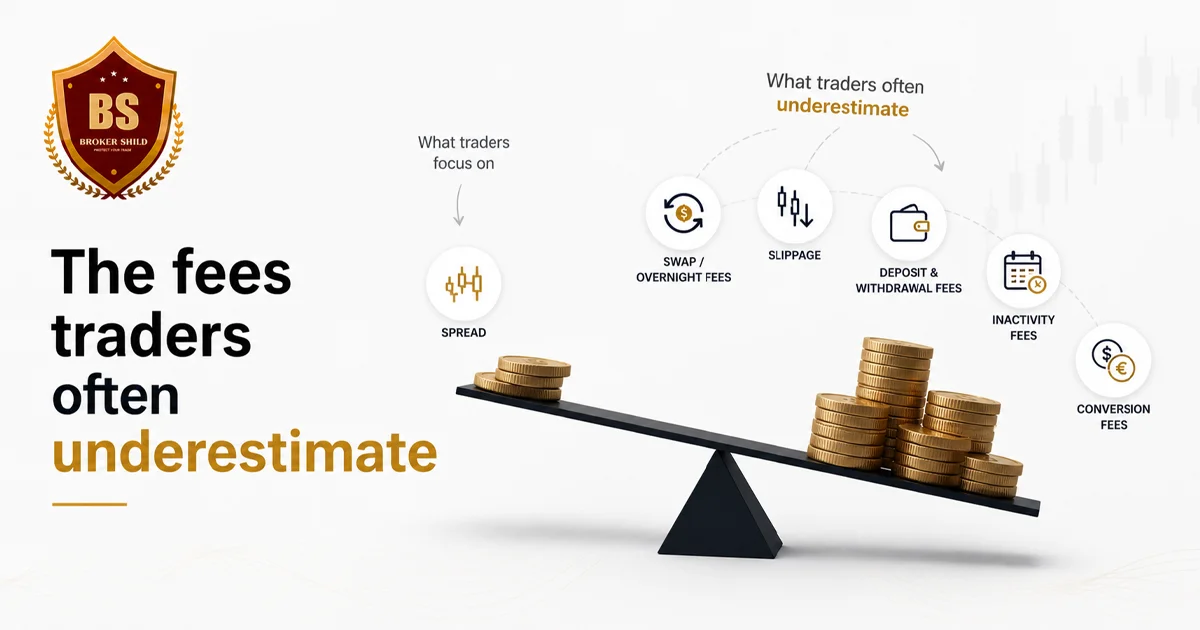
The most commonly overlooked broker cost is the swap, also called the overnight financing charge. If you hold leveraged CFD or forex positions overnight, you may pay or receive a financing adjustment based on the instrument, direction, broker markup, and prevailing rates. For many short-term traders, swap is minor. For swing traders and position traders, it can become one of the biggest recurring costs.
Swap-free accounts deserve extra attention. Some brokers offer them for religious reasons or as an account feature in certain regions. That does not always mean zero holding cost in every practical sense. Some brokers replace standard swaps with an administrative fee after a holding period. The label matters less than the actual charging method.
Currency conversion is another cost that gets missed. If your account base currency is USD but you trade, fund, or withdraw in another currency, the broker or payment provider may apply a conversion spread. This may look small on a single transaction, but it adds up for traders moving funds regularly.
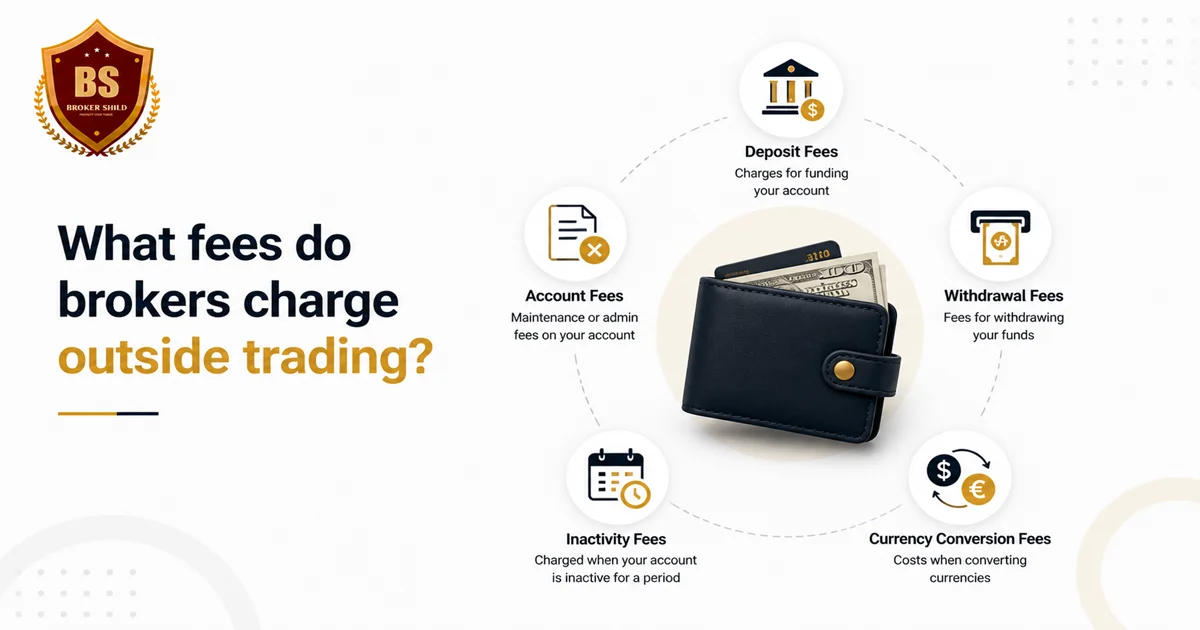
Non-trading fees vary more than many traders expect. Deposits are often free, but not always. Bank wires, card processors, and e-wallets can carry charges depending on region and method. A broker may not charge for the deposit itself, yet the payment provider still might.
Withdrawal fees are more common. Some brokers allow one or more free withdrawals each month, while others apply a flat fee per transaction. This especially matters for smaller accounts, where a fixed withdrawal charge can take a noticeable percentage of profits or capital.
Inactivity fees are another account-level charge. These are typically applied after a period with no trading activity, often several months. For active traders, they may never matter. For users who open an account, pause for a while, and return later, they can be relevant. The key is not to overreact to the existence of an inactivity fee, but to check when it begins and how much it is.
Platform fees are less common in retail forex and CFD trading, but they do exist in some cases. A broker may charge for advanced market data, premium tools, VPS hosting, or certain professional platforms. If you rely on algorithmic trading or third-party integrations, these costs should be part of your comparison.
A useful fee comparison starts with the instrument you actually trade. A broker that is competitive on EUR/USD may be less competitive on gold, NAS100, or minor forex pairs. Many traders make the mistake of comparing one flagship market and assuming the rest of the pricing is equally strong.
Next, look at the all-in cost. If a broker charges a 0.3 pip average spread plus a commission, convert that commission into pip equivalent for your typical trade size. This gives you a realistic round-trip number. Without that step, comparisons can be misleading.
You should also check average spreads, not just minimum spreads. Minimum spreads often appear in marketing because they look attractive, but they may only be available during the most liquid moments. Average spreads are usually a better indicator of day-to-day trading conditions.
Execution quality belongs in the same conversation. A slightly higher advertised cost can still be competitive if execution is stable and slippage is limited. By contrast, a broker with ultra-tight spreads on paper but weak order handling may produce worse results in practice.
Regional availability matters too. Traders in India, Southeast Asia, MENA, Africa, Europe, and Latin America often face different funding options, local payment costs, product restrictions, and account terms. The same broker can be cost-efficient in one country and less practical in another because of deposit methods, currency conversion, or product access.
Lower fees are good, but only within the context of trust, regulation, and trading conditions. A broker that saves you a fraction of a pip but creates friction with withdrawals, support, or execution quality is not necessarily lower cost overall. Trading expense is not just what appears on the fee page. It is what you actually pay while using the service.
This is where structured comparison helps. A data-based review should look at regulation, pricing model, average spreads, swap policy, funding costs, and execution conditions together. Looking at one fee in isolation rarely leads to a smart broker choice.
Beginners often benefit from choosing a broker with clear pricing, even if it is not the absolute cheapest on paper. Experienced traders may prefer a raw spread account with tighter all-in costs, provided execution quality is strong and the terms are consistent. There is no single best fee model for every trader.
Take one month of your typical activity and model it. Count how many trades you place, which instruments you use most, how long you hold positions, and how often you deposit or withdraw. Then apply each broker’s spread, commission, and overnight charges to that behavior.
This simple exercise usually reveals more than any headline claim. A day trader may find commissions matter most. A swing trader may discover swaps are the dominant cost. A casual trader may realize withdrawal and conversion charges have more impact than tiny spread differences.
If you compare brokers through that lens, the fee discussion becomes much clearer. Not cheaper in theory – cheaper for you.
A good broker fee comparison should leave you with fewer surprises, not just lower numbers on a pricing page.

Emma Thompson

Robert Walker