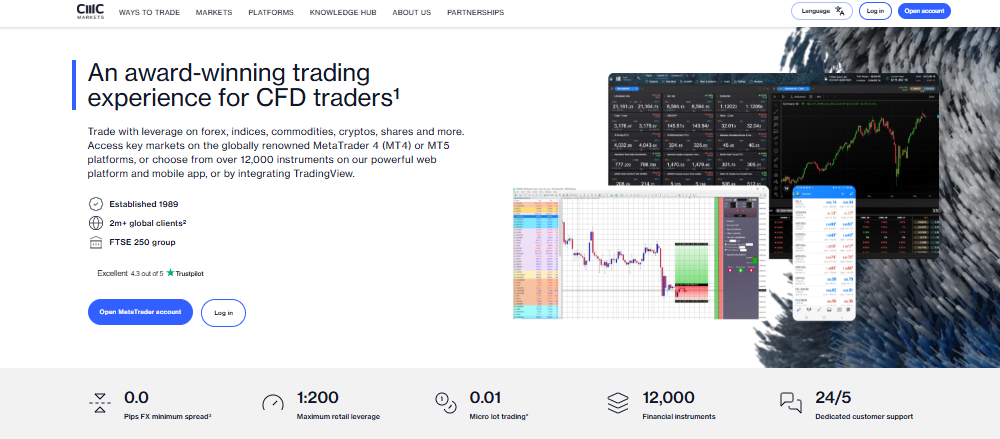
CMC Markets Review 2026 explains how CMC performs across pricing, regulation, platform depth, market range, and operational reliability. CMC Markets stands out as a multi-asset broker with broad product coverage, a strong proprietary platform, and a pricing model that becomes especially competitive for active forex traders.
This review focuses on the areas that matter most to serious traders: FX Active pricing, access to around 12,000+ instruments, support for Next Generation, MT4, MT5, and TradingView compatibility, and the practical differences between account structures and legal entities.

CMC Markets Review 2026 is a detailed broker analysis built for traders who want to understand how CMC Markets performs in real trading conditions. CMC is positioned as a serious multi-asset broker with broad access to forex, indices, commodities, shares, ETFs, bonds, and other leveraged markets. One of the strongest reasons traders consider CMC is the combination of market breadth, platform depth, and a pricing structure that can be very competitive when matched to the right account type.
In this CMC Markets Review 2026, the most important themes are clear. First, CMC offers access to around 12,000+ instruments, which makes it stronger than many narrower brokers that focus only on a smaller CFD lineup. Second, CMC supports a more advanced trading stack through the Next Generation platform, mobile access, MetaTrader 4, MetaTrader 5, and in some cases TradingView compatibility. Third, the broker’s pricing can look very attractive in forex because of the FX Active model, where spreads can start from 0.0 pips on 6 major pairs with a fixed commission structure.
At the same time, CMC Markets Review 2026 should not be reduced to a simple “cheap broker” narrative. CMC is more accurately described as a professional trading environment where price, execution, platform tools, research access, and entity-specific rules all interact. That means some traders will find CMC excellent value, while others may discover that differences in share CFD commissions, inactivity fees, funding costs, or product access depend heavily on the account structure and the legal entity serving the account.
Another important point in this CMC Markets Review 2026 is regulation and operational transparency. CMC operates through multiple regulated entities and is associated with several established financial regulators. That broader regulatory footprint gives the broker more credibility than smaller or less transparent CFD brands. CMC also highlights client money segregation, security controls around withdrawals, and formal legal documentation, all of which help support its trust profile.
Platform quality is also central to this CMC Markets Review 2026. CMC’s proprietary platform remains one of the broker’s biggest strengths because it is built for active market analysis rather than a simplified beginner-only workflow. Traders also benefit from access to risk management tools such as Guaranteed Stop-Loss Orders, research features, and a broader analytical environment than many brokers that only offer one basic web terminal. This helps explain why CMC often appeals more to intermediate and advanced traders than to absolute beginners.
Fees are where CMC needs a more careful reading. The FX Active model is clearly attractive on paper, but cost analysis should not stop at “spreads from 0.0 pips.” Real trading cost also depends on delivered spread, overnight financing, position size, share commission schedules, and whether inactivity fees apply under the account structure being used. This is why CMC Markets Review 2026 should be read as a broker review for serious comparison, not just a headline spread summary.
Overall, CMC Markets Review 2026 shows a broker with strong infrastructure, broad market access, and credible pricing potential for the right trader profile. CMC is especially compelling for users who want platform depth, serious charting, and flexible multi-market exposure. Traders should still verify their entity, account model, and target products before opening an account, because those three factors can materially change the true cost and experience of using CMC.

In this CMC Markets Review 2026, regulation is one of the broker’s strongest support points. CMC operates through multiple regulated entities and is associated with several well-established financial supervisors across major jurisdictions.
The strongest names associated with CMC include FCA, ASIC, MAS, BaFin, FMA, and BMA, depending on the entity serving the account.
CMC highlights client money segregation, formal legal documentation, and stronger operational controls. Withdrawal security measures such as 2FA are also part of the broader trust profile.
CMC Markets pricing is strongest when read through the right account model. FX Active is the clear highlight for active forex traders, while share CFD commissions, inactivity fees, and financing charges can vary more noticeably depending on product and entity.
CMC states that FX Active offers spreads from 0.0 pips on 6 major pairs with a fixed commission of $2.50 per $100,000 per side. For many active traders, this is the part of CMC’s pricing model that makes the broker highly competitive.
Low headline spread alone is not enough. Real cost depends on delivered spread, execution conditions, overnight financing, and the pairs you trade most often.
| Pricing Element | CMC Markets FX Active | Assessment |
|---|---|---|
| Major pair spread | From 0.0 pips on 6 major pairs | Very competitive |
| Commission model | $2.50 per $100,000 per transaction | Clear fixed model |
| Round-turn example | Roughly $5 on a $100k trade size | Active-trader friendly |
| Wider FX coverage | CMC also references pricing advantages across 300+ other pairs | Needs pair-specific check |
The standard model builds most trading cost into the spread. CMC’s official materials often show “from” pricing, while external testing may report different typical averages depending on instrument, timing, and methodology.
Standard pricing is easier to read than commission-plus-spread models, but traders should compare delivered spreads during their own trading hours, not just marketing examples.
| Instrument / Market | Sample Pricing Reference | Assessment |
|---|---|---|
| EUR/USD | Official educational materials often reference pricing from around 0.7 points | Competitive |
| GBP/USD | Can trade wider than EUR/USD depending on conditions and methodology | Pair-dependent |
| UK 100 / Germany 40 | Starting-from pricing often shown around 1.0 point in official examples | Solid index pricing |
| US SPX 500 | External testing often points to competitive spreads around 0.6 | Strong benchmark |
CMC’s share CFD pricing is not globally uniform. Some official materials reference clear per-share commission examples, while other materials describe zero-commission access on selected large subsets of shares and ETFs.
This is one of the most entity-sensitive parts of CMC’s pricing. Do not position share CFD fees as globally fixed unless you are targeting a specific jurisdiction page.
| Category | Sample Pricing Structure | Assessment |
|---|---|---|
| US share CFD example | $0.02 per share with a $10 minimum commission | Clear example |
| Selected UK / Europe share CFDs | Some official materials reference zero commission on a large subset | Potential advantage |
| Entity sensitivity | Commission model can change materially by legal entity and product line | Needs verification |
Overnight financing, GSLO premium, market data charges, and inactivity fees can materially affect long-term or low-frequency traders. This is where many review pages stay too shallow.
Use this section to show that CMC pricing is strong, but not universally simple. That creates a more trustworthy review than just repeating spread marketing.
| Cost Type | What to Expect | Assessment |
|---|---|---|
| Overnight financing | Applies to positions held beyond cut-off | Important for swing traders |
| GSLO premium | Charged when using guaranteed stop-loss functionality | Risk-tool cost |
| Market data fees | May apply on selected markets or user classifications | Market-specific |
| Inactivity fee | Can apply in some setups after an extended period without activity | Low-activity caution |
CMC’s proprietary platform remains the core of its trading ecosystem and is one of the broker’s strongest differentiators for active traders.
CMC also supports MetaTrader access, including workflows that appeal to traders using EAs and more traditional forex terminal setups.
Official materials reference TradingView compatibility in selected setups, which strengthens the charting and workflow appeal for many traders.
Guaranteed Stop-Loss Orders are supported with a premium-based structure, and the initial premium can be refunded if the order is not triggered.
CMC materials reference features such as Morningstar quantitative analysis and Reuters news access in selected product environments.
CMC highlights strong fill-rate and automated execution claims in official materials, which supports its positioning as a broker for active trading.
Funding and withdrawal experience at CMC should be described carefully because methods, processing times, and internal charges can differ by entity and payment route.
This comparison highlights how CMC Markets stacks up against IG and Saxo across pricing profile, platform depth, and overall broker positioning for serious traders.
CMC Markets Review 2026 places CMC firmly in the category of serious trading infrastructure rather than beginner-only brokerage. The strongest case for CMC is its combination of platform quality, FX Active pricing, and broad multi-asset access.
The biggest trade-off is structure complexity. Traders should not treat CMC as a one-size-fits-all broker. Entity, account model, and target market all have a direct effect on the real user experience, including spreads, commissions, inactivity rules, and funding conditions.
For active traders who value platform depth and better overall broker infrastructure, CMC remains a strong contender.
CMC can be suitable for international traders who want a multi-asset environment, but product fit depends heavily on trading experience, leverage awareness, and account structure.
CMC is associated with multiple regulated entities across major jurisdictions, including well-known regulators such as FCA, ASIC, MAS, BaFin, FMA, and BMA depending on the entity.
FX Active is CMC’s commission-based forex pricing model, with spreads from 0.0 pips on 6 major pairs and a fixed commission structure tied to notional trade value.
Inactivity fees can apply in some account structures after an extended period without trading activity, although rules can vary depending on the setup and product line.
Official support materials commonly reference bank transfer, card funding, and PayPal in selected cases, while timelines and internal costs can vary by entity and payment route.
CMC’s wider disclosure record includes references to remediation and regulatory-review-related matters in selected jurisdictions, as well as public warnings about clone websites misusing the brand.
Have you used this broker? Share your experience and help other traders make smarter decisions.
No user reviews yet. Be the first to rate this broker.